Simrad HALO20+ vs Raymarine Quantum 2: a compact radar comparison
Choose between HALO20+ and Quantum 2 for a compact boat, weighing display compatibility, electrical demand and a practical installation plan.
Manufacturer documentation with editorial analysis; no hands-on testing or comparative sea trials. Sources checked 3 October 2026.
HALO20+ and Quantum 2 are sensible compact-radome candidates in different display systems. Choose the supported system first; compare the scanner second. An owner retaining a compatible Simrad helm has a different buying problem from an owner retaining a Raymarine helm.
#Side by side
Shaded rows contain different values. On a small screen, scroll the table; model names stay visible within it.
| Published detail | HALO20+ | Quantum 2 Q24D |
|---|---|---|
| Dome diameter | 510 mm | 541 mm |
| Horizontal beamwidth | 4.9° native | 4.9° nominal |
| Rotation | Up to 60 RPM at short ranges | 24 RPM nominal |
| Published electrical draw | 20 W typical / 29 W maximum | 17 W maximum in transmit mode |
| Doppler feature | VelocityTrack | Doppler target display |
Sources: Simrad HALO20+ and Raymarine Quantum 2. These are published specifications, not measurements from a common test. HALO20 without the plus sign is a different product and should not be substituted in a quote.
#Example: a small motor cruiser
Consider a motor cruiser whose owner wants better situational information on early departures. The first inspection finds a working Simrad screen, a suitable mounting arch and a difficult route for new cables. The next step is to check that exact screen's support for HALO20+, then price the complete job. Buying Quantum 2 on scanner price alone would leave the display question unanswered.
Now change one assumption: the boat already has a compatible Raymarine display. The shortlist changes even though the owner's boating has not. This is why our recommendation does not declare an unconditional winner. The system aboard is part of the product comparison, not an inconvenient detail to ignore.
#Translate specifications into useful questions
Faster rotation is a reason to inspect how quickly the complete system updates in the supported operating mode. It is not proof that every echo will be stronger or easier to interpret. Likewise, matching beamwidth figures do not establish identical processing, clutter handling or target tracking.
Ask to see controls for target acquisition, range and clutter before choosing. On the boat, inspect the proposed scanner's view, power supply and heading source. If a wireless imagery link is proposed for Quantum 2, have the supplier confirm display and software support and explain recovery after a lost connection. Its power supply remains a physical installation.
#Which quote should win?
Give preference to the quote that keeps useful equipment, documents compatibility and includes commissioning. Request the exact scanner, cables, mount, display changes and tax treatment in writing. No Australian installed price has been verified here, so we do not award a value-for-money score from foreign prices.
For an owner starting from scratch, compare helm operation and the wider equipment plan alongside the two radomes. For an owner retaining equipment, changing ecosystems needs a specific benefit large enough to justify that work. Use the radar practice scenario to design a useful training session after installation rather than treating a new scanner as an automatic improvement in judgement.
#Example: a compact sailing boat with limited electrical capacity
Imagine a coastal yacht with a working display and no radar. First establish whether that exact display supports the proposed scanner. If it does, retaining it may save more than any scanner-price difference. If it does not, request a complete replacement proposal including charts, network parts and the crew’s familiarisation with changed controls.
Next record available mounting space and the route for power and imagery. Wireless capability, where supported, does not remove the scanner’s electrical supply or the need to assess the signal path. Put the selected manual’s mounting and clearance requirements beside the installer’s drawing. A compact dome is not automatically suitable for every small yacht.
#Build a power budget without turning unlike figures into a test
Use manufacturer electrical limits for the preliminary design and measured finished-system loads for passage estimates. Do not subtract HALO’s typical figure from Quantum’s maximum and call the result a proven real-world saving. Add the screen, heading source and network equipment, and account for time in different modes.
Shaded rows contain different values. On a small screen, scroll the table; model names stay visible within it.
| Owner question | Evidence to request |
|---|---|
| Will it fit? | Model-specific clearances and actual mount assessment |
| Will it display? | Exact supported display and software |
| Will my battery plan support it? | Whole-system load calculation and measured verification |
| Can the crew use it? | Demonstration and planned practice session |
| Is changing brands worthwhile? | Complete installed scope including retained-equipment losses |
#Budget and premium answers can be the same
The budget owner should protect reliable installation and training rather than spend everything on a scanner. The premium owner should still choose the compact radar that meets the brief if a larger refit adds no useful capability. More available money can improve service access, source quality and an independent navigation path without changing the scanner choice.
On a catamaran, add the network route to the sheltered station and the visibility of the chosen radar view. On a monohull, check the working cockpit under sail and whether the controls remain reachable while braced. Those practical differences can outweigh a small dome-size difference. The catamaran versus monohull guide helps turn the comparison into an installation brief.
Continue building the system
These guides pick up where this one stops.
Head-to-head
Simrad HALO20+ vs HALO24: which radome fits your boat?
Compare HALO20+ and HALO24 beamwidth, size, power and installation requirements. Decide whether the larger dome earns its place on your boat.
Decision Compare the two options against your existing system and installation.Check first Display support and mounting space can outweigh the scanner price.Also needed Exact scanner and supported display/software Read the guideHead-to-head
Raymarine Quantum 2 vs Garmin Fantom 18x: which system fits?
Compare Quantum 2 and Fantom 18x radar for a complete helm refit, including published power, mounting weight and the cost of changing displays.
Decision Compare the two options against your existing system and installation.Check first Changing the display ecosystem can dominate the complete cost.Also needed Exact scanner and supported display/software Read the guideRanked shortlist
Top 3 compact marine radars for a cruising-yacht refit
A ranked compact-radar shortlist for a cruising yacht, with explicit selection criteria, ecosystem exceptions and links to detailed model comparisons.
Best for A new power-conscious cruising-yacht helmCheck first Order changes with retained equipment; no comparative sea trial or installed-price test.Also needed Complete regional package and a comparable installation quote Read the guide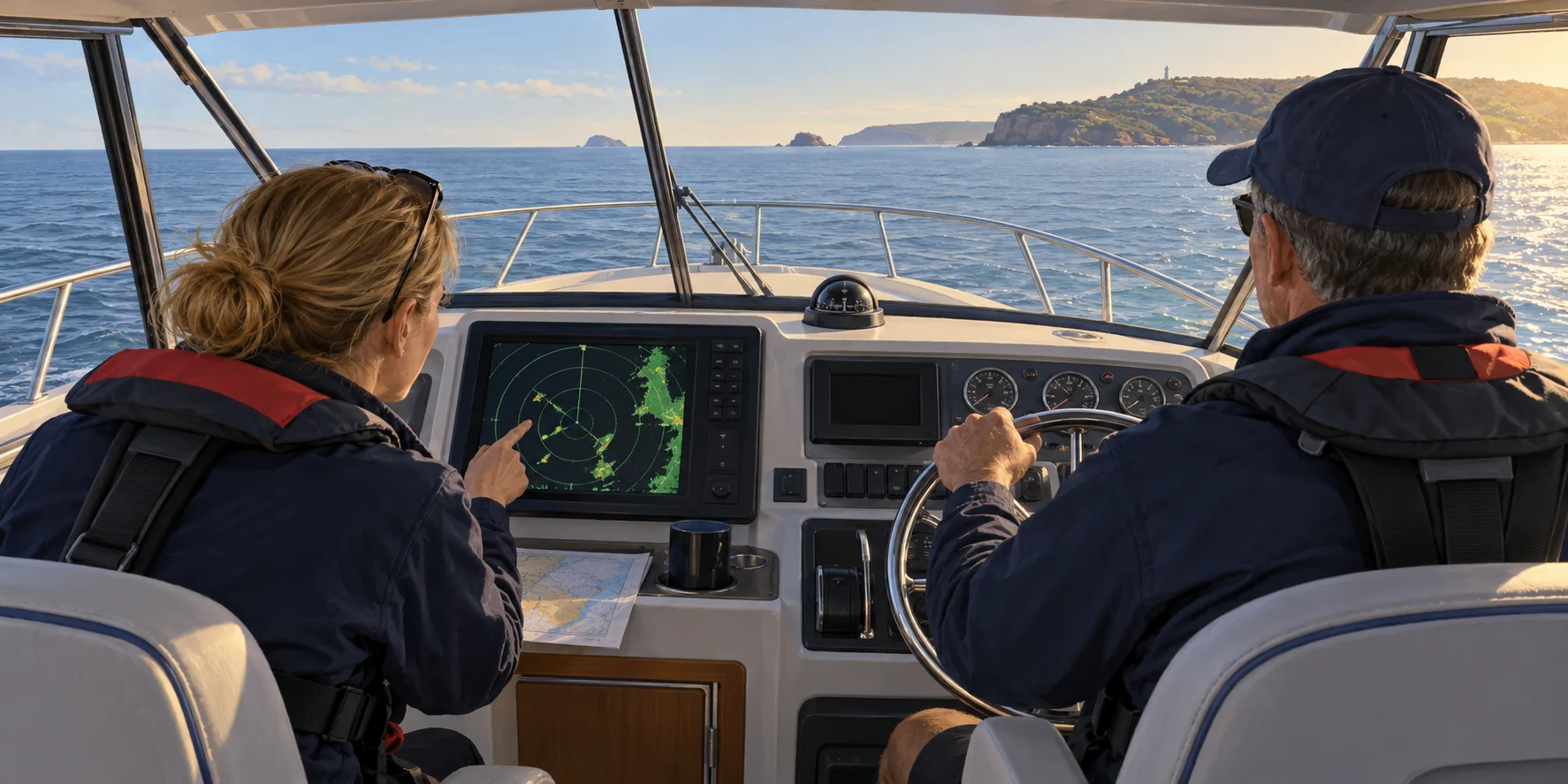 AI illustration
Worked example
Radar in action: a clear-weather training scenario
A structured, hypothetical radar practice session for a newly installed system, connecting product choice with observation, settings and useful records.
Best for A supervised clear-weather radar sessionCheck first An illustrative exercise is not a collision-manoeuvre planAlso needed Accepted installation, suitable conditions and competent supervision Read the guideBuying Guides
Best marine radar 2026
The best radar is not the one with the biggest range number. These are the 2026 picks by vessel type, and the four things worth more attention than the spec sheet.
Read the guideHead-to-head
Radome vs open array
The honest answer is that beam width is real physics and windage aloft is real seamanship. Which wins depends on the boat, not the budget.
Read the guideReferenced by
Other guides that depend on the ideas on this page.
This guide is independent editorial information, not a substitute for official regulation. Equipment requirements, licensing and chart currency differ by jurisdiction and change over time — confirm the current position with the AMSA, the Australian Hydrographic Office, ACMA and your state or territory maritime authority before relying on it.